Available AO instruments - Input Files and Corresponding Results
🗂️ This page provides .ini configuration files tailored for various instruments: ERIS, GNAO, HARMONI, MAVIS,
METIS, MICADO, MORFEO, MUSE, SOUL, SPHERE.
Click here to access an interface that lets you generate custom .ini files by selecting your instrument and parameter values.
➡️ERIS (Enhanced Resolution Imager and Spectrograph)
The Enhanced Resolution Imager and Spectrograph (ERIS) is a near-infrared instrument at the Cassegrain focus of UT4. ERIS instrument has two science cameras; SPIFFIER, an integral field spectrograph covering J to K bands, and NIX, an imager covering J to M bands.
(More information can be found at: https://www.eso.org/sci/facilities/paranal/instruments/eris.html)
AO mode used:
🔵 Single Conjugate Adaptive Optics (SCAO)
Guide star types:
- Natural Guide Star (NGS): requires guide star with
R<11mag, either on and off-axis (up to60"possible, although<30"recommended due to anisoplanatism) - Laser Guide Star (LGS): requires tip-tilt star within
60"with R magnitude in the range7–18mag . Laser spot is initially on-axis, moving relative to target as telescope offsets are applied.
Parameter file (.ini format) - 🔵SCAO NGS✴️
View parameter file contents (.ini)
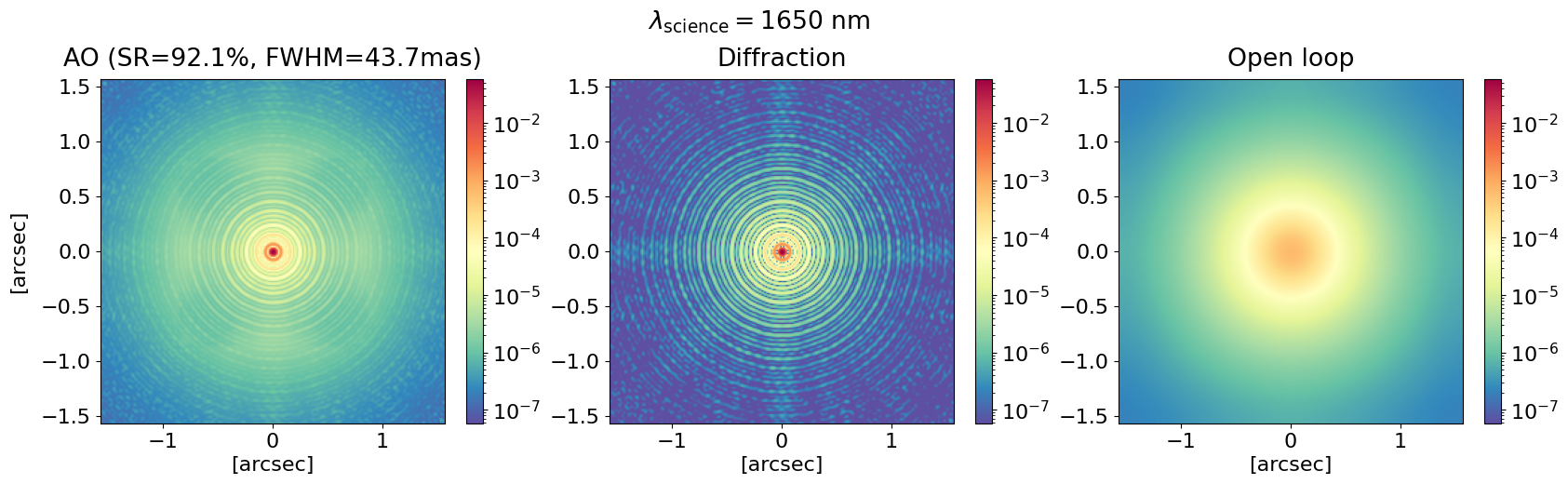
Loading...ERIS SCAO NGS - PSFs
Parameter file (.ini format) - 🔵SCAO LGS✳️
View parameter file contents (.ini)
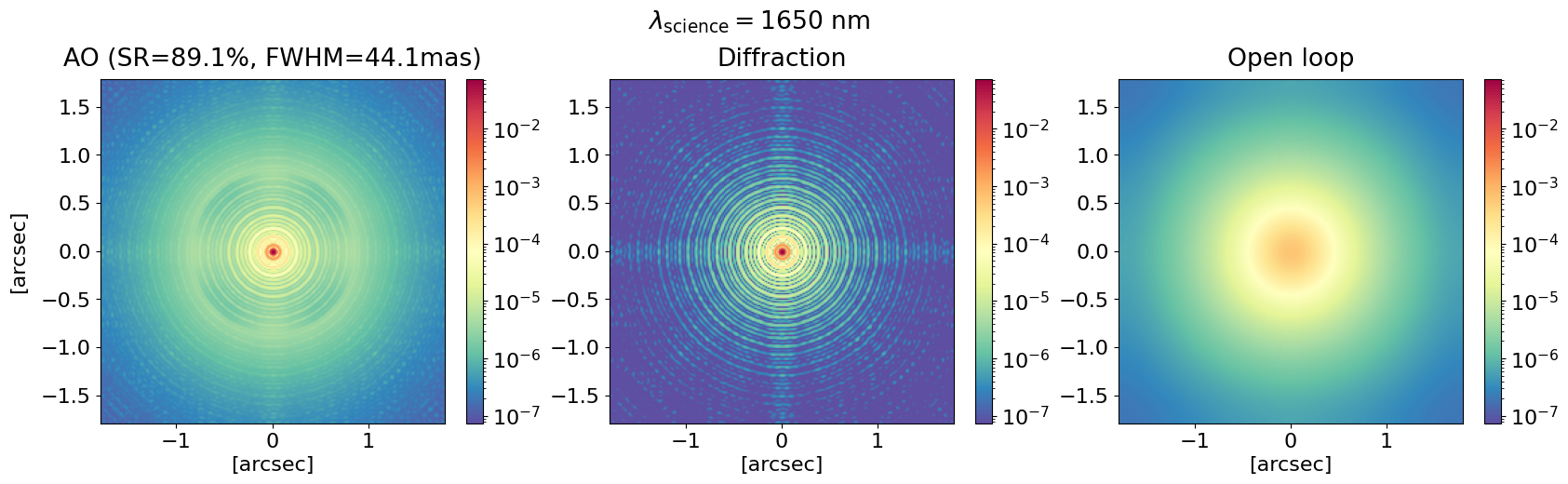
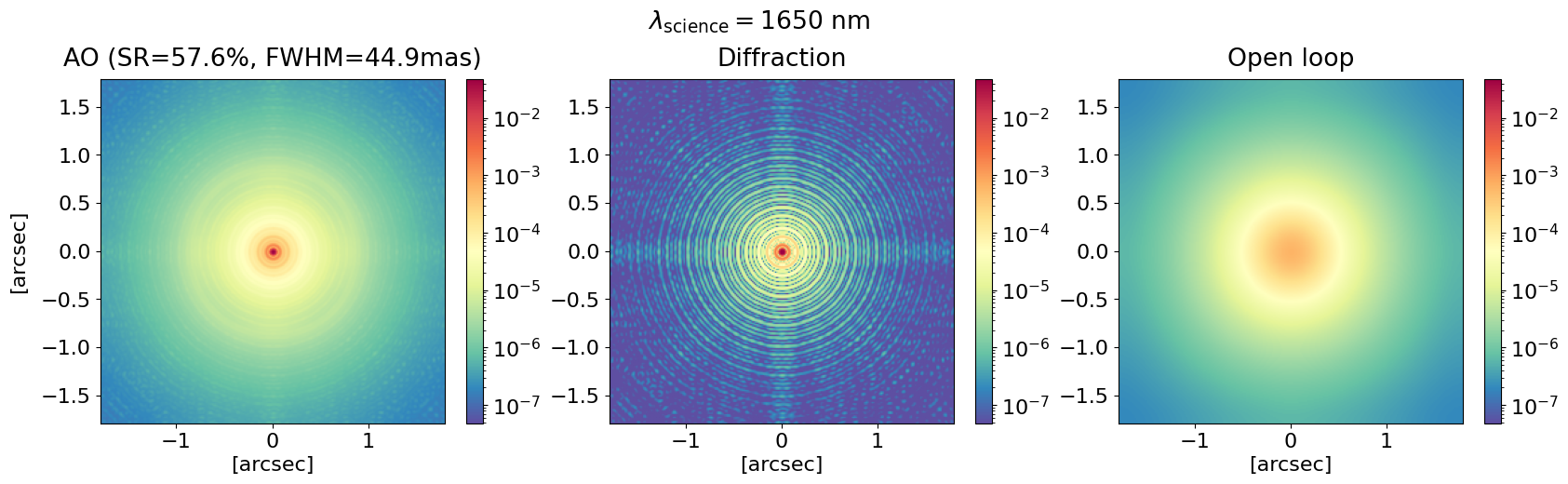
Loading...ERIS SCAO LGS - PSFs
➡️GNAO (Gemini North Adaptive Optics system)
The Gemini North Adaptive Optics system (GNAO) is the next-generation adaptive optics facility for the Gemini-North telescope, developed as part of the National Science Foundation-funded Gemini in the Era of Multi-Messenger Astronomy (GEMMA) program. GNAO will replace the current single-conjugate ALTAIR facility with a modern wide-field adaptive optics (AO) system for science in the near-infrared, supported by four laser guide stars and fully integrated into the Gemini queue observing. The design of GNAO is optimized for two main modes:
- Narrow-field mode: Near-diffraction-limited performance over an approximately 20”x20” field of view (via laser tomography AO)
- Wide-field mode: Seeing-enhanced performance over a 2-arcmin diameter field-of-view (via ground-layer AO).
(Text sourced from: https://www.gemini.edu/instrumentation/future-instruments/gnao)
AO modes used:
🟤 Ground Layer Adaptive Optics (GLAO)
🟢 Laser Tomography Adaptive Optics (LTAO)
Parameter file (.ini format) - 🟢LTAO
View parameter file contents (.ini)
Loading...You can also use the script below to generate your own .ini configuration files
for the GNAO narrow-field mode.
The full ini_maker_GNAO_NF.py script is available for download
here📥.
Script for GNAO .ini configuration file: ini_maker_GNAO_NF.py
# -*- coding: utf-8 -*-
"""
Generate a TIPTOP-style .ini configuration file for GNAO narrow-field mode.

How to use
----------
1. Edit the values in the "RUN CONFIGURATION (edit here)" section
at the end of the file.
2. Run the script.
3. The corresponding .ini file will be written.

Main user options
-----------------
profile : int
Atmospheric profile index:
    0 = poorer seeing
    1 = median seeing
    2 = better seeing

mcao : bool
Enables the internal multi-DM / multi-conjugate simulation branch.

ait : bool
If True, use the simplified AIT atmospheric profile.
If False, use the nominal atmospheric profile.

ngs_mode : int
Natural guide star mode:
    1 = bright on-axis NGS
    2 = sky-coverage mode

opt_mode : int
DM optimization mode:
    1 = field optimization
    2 = on-axis optimization

only_on_axis : bool
If True, only the on-axis science target is used.
If False, the full science field grid is used.

nyquist_sci_mode : int
Science pixel scale mode:
    0 = fixed 25 mas
    1 = Nyquist-based sampling

output_file : str
Name of the generated .ini file.

cn2_perturb_percent : float | None
Optional Gaussian perturbation amplitude applied to the Cn2 weights,
expressed in percent.

cn2_seed : int | None
Optional random seed for reproducible Cn2 perturbations.

Typical example
---------------
Default GNAO narrow-field / LTAO-like case:
profile=1
mcao=False
ait=False
ngs_mode=1
opt_mode=2
only_on_axis=True

Output
------
The script writes a TIPTOP-style configuration file with the sections:
[telescope]
[atmosphere]
[sources_science]
[sources_HO]
[sources_LO]
[sensor_science]
[sensor_HO]
[sensor_LO]
[DM]
[RTC]

@authors: pjouve & astro-tiptop-services
"""

from __future__ import annotations

import configparser
from dataclasses import dataclass
from pathlib import Path
from typing import Any

import numpy as np


# ----------------------------------------------------------------------
# Utilities
# ----------------------------------------------------------------------

def cart2pol(x: np.ndarray | float, y: np.ndarray | float):
"""Convert Cartesian coordinates to polar coordinates."""
rho = np.sqrt(x**2 + y**2)
phi = np.arctan2(y, x)
return rho, phi


def perturb_cn2_gaussian(weights, percent_sigma, seed=None):
"""
Apply multiplicative Gaussian perturbation to Cn2 weights.

Parameters
----------
weights : list[float]
    Initial Cn2 weights.
percent_sigma : float
    Standard deviation in percent, e.g. 10 means 10%.
seed : int | None
    Optional random seed.

Returns
-------
list[float]
    Perturbed and renormalized weights.
"""
rng = np.random.default_rng(seed)
weights = np.array(weights, dtype=float)
sigma = percent_sigma / 100.0
noise = rng.normal(0.0, sigma, size=len(weights))
w_new = weights * (1.0 + noise)
w_new[w_new < 0] = 1e-12
w_new /= np.sum(w_new)
return w_new.tolist()


def make_square_field(radius_arcsec: float, n_points: int):
"""
Build a square grid in Cartesian coordinates and return polar lists.

Returns
-------
zenith : list[float]
azimuth : list[float]
"""
mesh = np.mgrid[
    -radius_arcsec:radius_arcsec:complex(0, n_points),
    -radius_arcsec:radius_arcsec:complex(0, n_points),
]
x_mesh = mesh[0, :, :]
y_mesh = mesh[1, :, :]
r, t = cart2pol(x_mesh, y_mesh)
az_deg = t * 180.0 / np.pi
return r.flatten().tolist(), az_deg.flatten().tolist()


def stringify_listlike(value: Any) -> str:
"""Convert a Python object to the string format expected in the ini file."""
return str(value)


# ----------------------------------------------------------------------
# Configuration model
# ----------------------------------------------------------------------

@dataclass
class SimulationOptions:
profile: int = 1               # atmospheric case: 0, 1, 2
mcao: bool = False
ait: bool = False
ngs_mode: int = 1              # 1: on-axis bright, 2: faint off-axis NGS
opt_mode: int = 2              # 1: field optimization, 2: on-axis optimization
only_on_axis: bool = True
nyquist_sci_mode: int = 1      # 0: fixed 25 mas, 1: Nyquist-based
output_file: str = "GNAO.ini"
cn2_perturb_percent: float | None = None
cn2_seed: int | None = None


# ----------------------------------------------------------------------
# Builders
# ----------------------------------------------------------------------

def build_atmosphere(opts: SimulationOptions):
"""Build atmosphere-related parameters."""
wavelength_at = 500e-9
r0_list = [0.135, 0.186, 0.247]

if opts.profile not in (0, 1, 2):
    raise ValueError("profile must be 0, 1, or 2")

r0 = r0_list[opts.profile]
seeing = 500e-9 / r0 * 206265
l0 = 30.0

if not opts.ait:
    cn2_profiles = {
        0: [0.3952, 0.1665, 0.0703, 0.0773, 0.0995, 0.1069, 0.0843],
        1: [0.4550, 0.1295, 0.0442, 0.0506, 0.1167, 0.0926, 0.1107],
        2: [0.5152, 0.0951, 0.0322, 0.0262, 0.1160, 0.0737, 0.1416],
    }
    cn2_weights = cn2_profiles[opts.profile]
    cn2_heights = [0, 500, 1000, 2000, 4000, 8000, 16000]
    wind_speed = [5.6, 5.77, 6.25, 7.57, 13.31, 19.06, 12.14]
    wind_direction = [190, 255, 270, 350, 17, 29, 66]
else:
    if opts.profile == 0:
        cn2_weights = [0.3952, 0.1665, 0.0703, 0.0773, 0.0995, 0.1069, 0.0843]
    elif opts.profile == 1:
        cn2_weights = [0.5794, 0.2948, 0.1258]
    else:
        cn2_weights = [0.6166, 0.2632, 0.1202]

    cn2_heights = [0, 4000, 12000]
    wind_speed = [7 * 0.7, 13 * 0.7, 30 * 0.7]
    wind_direction = [45, 255, 270]

cn2_weights_mod = cn2_weights.copy()
if opts.cn2_perturb_percent is not None:
    cn2_weights_mod = perturb_cn2_gaussian(
        cn2_weights_mod,
        percent_sigma=opts.cn2_perturb_percent,
        seed=opts.cn2_seed,
    )

return {
    "Wavelength": wavelength_at,
    "Seeing": seeing,
    "L0": l0,
    "Cn2Weights": cn2_weights,
    "Cn2Heights": cn2_heights,
    "WindSpeed": wind_speed,
    "WindDirection": wind_direction,
    "Cn2Weights_mod1": cn2_weights_mod,
}


def build_telescope(opts: SimulationOptions):
"""Build telescope section."""
jitter_fwhm = 0.0 if opts.ngs_mode == 1 else 17 * 2.17

return {
    "TelescopeDiameter": 7.9,
    "ZenithAngle": 30,
    "ObscurationRatio": 0.1646,
    "Resolution": 128,
    "PathPupil": '"ELT_pup.fits"',
    "PathStaticOn": "'CombinedError_Wavefront_nm.fits'",
    "PathApodizer": "''",
    "PathStatModes": "''",
    "PupilAngle": 0.0,
    "TechnicalFoV": 120,
    "jitter_FWHM": jitter_fwhm,
    "extraErrorNm": 0,
    "extraErrorExp": -2,
    "extraErrorMin": 0,
}


def build_sources_science(opts: SimulationOptions):
"""Build science source positions."""
wavelength_sci = [2179e-9]
zenith_sci, azimuth_sci = make_square_field(radius_arcsec=10, n_points=9)

if opts.only_on_axis:
    zenith_sci = [0]
    azimuth_sci = [0]

return {
    "Wavelength": wavelength_sci,
    "Zenith": zenith_sci,
    "Azimuth": azimuth_sci,
}


def build_sources_ho(opts: SimulationOptions):
"""Build high-order guide star constellation."""
lgs_sz = 30 if opts.mcao else 10
return {
    "Wavelength": 589e-9,
    "Zenith": [lgs_sz, lgs_sz, lgs_sz, lgs_sz],
    "Azimuth": [45, 135, 225, 315],
    "Height": 90e3,
}


def build_sources_lo(opts: SimulationOptions):
"""Build low-order guide star."""
x_lo_list = [0]
y_lo_list = [0] if opts.ngs_mode == 1 else [50]

r = np.sqrt(np.array(x_lo_list) ** 2 + np.array(y_lo_list) ** 2)
t = np.arctan2(np.array(y_lo_list), np.array(x_lo_list)) * 180 / np.pi

return {
    "Wavelength": 700e-9,
    "Zenith": [float(v) for v in r],
    "Azimuth": [float(v) for v in t],
}


def build_sensor_science(opts: SimulationOptions, telescope: dict, sources_science: dict):
"""Build science detector section."""
wavelength_sci = sources_science["Wavelength"][0]
telescope_diameter = telescope["TelescopeDiameter"]
nyquist_sci = 2
pix = wavelength_sci / telescope_diameter * 206265000 / 2 / nyquist_sci
pixel_scale_sci = pix if opts.nyquist_sci_mode == 1 else 25

return {
    "PixelScale": pixel_scale_sci,
    "FieldOfView": 240,
    "Binning": 1,
    "NumberPhotons": [1500],
    "SpotFWHM": [[0.0, 0.0, 0.0]],
    "SpectralBandwidth": 0.0,
    "Transmittance": [1.0],
    "Dispersion": [[0.0], [0.0]],
    "SigmaRON": [1.0],
    "Dark": 0.0,
    "SkyBackground": 1.0,
    "Gain": 1.0,
    "ExcessNoiseFactor": 1.0,
}


def build_sensor_ho(opts: SimulationOptions):
"""Build HO WFS section."""
add_mcao_wfs_sens_cone_error = bool(opts.mcao)

nphoton = 384
n_lenslet = 25

return {
    "WfsType": "'Shack-Hartmann'",
    "Modulation": None,
    "PixelScale": 830,
    "FieldOfView": 240,
    "Binning": 1,
    "NumberPhotons": [nphoton, nphoton, nphoton, nphoton],
    "SpectralBandwidth": 0.0,
    "Transmittance": [1.0],
    "Dispersion": [[0.0], [0.0]],
    "SigmaRON": 0.5,
    "Dark": 0.0,
    "SkyBackground": 0.0,
    "Gain": 1.0,
    "ExcessNoiseFactor": 1.31,
    "NumberLenslets": [n_lenslet, n_lenslet, n_lenslet, n_lenslet],
    "NoiseVariance": [None],
    "Algorithm": "'wcog'",
    "WindowRadiusWCoG": 6,
    "ThresholdWCoG": 0.0,
    "NewValueThrPix": 0.0,
    "addMcaoWFsensConeError": add_mcao_wfs_sens_cone_error,
}


def build_sensor_lo(opts: SimulationOptions):
"""Build LO WFS section."""
if opts.ngs_mode == 1:
    mag_list = [5]
    freq_tt = 1000
else:
    mag_list = [19.76]
    freq_tt = 100

f0 = 4.34e10
throughput = 0.42
nph0 = 10 ** (-np.array(mag_list) / 2.5) * 47 * f0 * throughput / freq_tt

return {
    "PixelScale": 250.0,
    "FieldOfView": 4,
    "Binning": 1,
    "NumberPhotons": [float(v) for v in nph0],
    "SpotFWHM": [[0.0, 0.0, 0.0]],
    "SigmaRON": 0.5,
    "Dark": 0.0,
    "SkyBackground": 0.0,
    "Gain": 1.0,
    "ExcessNoiseFactor": 1.3,
    "NumberLenslets": [1],
    "Algorithm": "'wcog'",
    "WindowRadiusWCoG": 4,
    "ThresholdWCoG": 0.0,
    "NewValueThrPix": 0.0,
    "noNoise": False,
    "filtZernikeCov": bool(opts.mcao),
}


def build_dm(opts: SimulationOptions):
"""Build deformable mirror section."""
if not opts.mcao:
    number_actuators_dm = [26]
    dm_pitchs_dm = [0.24]
    inf_coupling_dm = [0.3]
    dm_heights_dm = [0.0]
else:
    number_actuators_dm = [32, 20]
    dm_pitch_alt = (0.5 * 10 + 7.9) / (20 - 1)
    dm_pitchs_dm = [0.24, dm_pitch_alt]
    inf_coupling_dm = [0.3, 0.3]
    dm_heights_dm = [0.0, 10000]

number_of_point_opt = 3
zenith_sci_opt, azimuth_sci_opt = make_square_field(radius_arcsec=10, n_points=number_of_point_opt)
sz = len(zenith_sci_opt)

if opts.opt_mode == 1:
    optimization_zenith_dm = zenith_sci_opt
    optimization_azimuth_dm = azimuth_sci_opt
    optimization_weight_dm = list(np.ones(sz) / sz)
else:
    optimization_zenith_dm = [0]
    optimization_azimuth_dm = [0]
    optimization_weight_dm = [1]

return {
    "NumberActuators": number_actuators_dm,
    "DmPitchs": dm_pitchs_dm,
    "InfModel": "'gaussian'",
    "InfCoupling": inf_coupling_dm,
    "DmHeights": dm_heights_dm,
    "OptimizationZenith": optimization_zenith_dm,
    "OptimizationAzimuth": optimization_azimuth_dm,
    "OptimizationWeight": optimization_weight_dm,
    "OptimizationConditioning": 1.0e2,
    "NumberReconstructedLayers": 7,
    "AoArea": "'circle'",
}


def build_rtc(opts: SimulationOptions):
"""Build RTC section."""
sensor_frame_rate_lo = 1000 if opts.ngs_mode == 1 else 100

return {
    "LoopGain_LO": "'optimize'",
    "LoopGain_HO": 0.5,
    "SensorFrameRate_HO": 500.0,
    "LoopDelaySteps_HO": 2,
    "SensorFrameRate_LO": sensor_frame_rate_lo,
    "LoopDelaySteps_LO": 2,
}


# ----------------------------------------------------------------------
# INI writer
# ----------------------------------------------------------------------

def dict_to_ini_sections(config: configparser.ConfigParser, section_name: str, values: dict):
"""Write a dict into a configparser section."""
config[section_name] = {}
for key, value in values.items():
    config[section_name][key] = stringify_listlike(value)


def generate_config(opts: SimulationOptions) -> configparser.ConfigParser:
"""Generate the full configparser object."""
config = configparser.ConfigParser()
config.optionxform = str  # keep case

telescope = build_telescope(opts)
atmosphere = build_atmosphere(opts)
sources_science = build_sources_science(opts)
sources_ho = build_sources_ho(opts)
sources_lo = build_sources_lo(opts)
sensor_science = build_sensor_science(opts, telescope, sources_science)
sensor_ho = build_sensor_ho(opts)
sensor_lo = build_sensor_lo(opts)
dm = build_dm(opts)
rtc = build_rtc(opts)

dict_to_ini_sections(config, "telescope", telescope)
dict_to_ini_sections(config, "atmosphere", atmosphere)
dict_to_ini_sections(config, "sources_science", sources_science)
dict_to_ini_sections(config, "sources_HO", sources_ho)
dict_to_ini_sections(config, "sources_LO", sources_lo)
dict_to_ini_sections(config, "sensor_science", sensor_science)
dict_to_ini_sections(config, "sensor_HO", sensor_ho)
dict_to_ini_sections(config, "sensor_LO", sensor_lo)
dict_to_ini_sections(config, "DM", dm)
dict_to_ini_sections(config, "RTC", rtc)

return config


def write_ini(config: configparser.ConfigParser, output_file: str):
"""Write config to disk."""
output_path = Path(output_file)
with output_path.open("w", encoding="utf-8") as f:
    config.write(f)
return output_path


# ----------------------------------------------------------------------
# RUN CONFIGURATION (edit here)
# ----------------------------------------------------------------------

if __name__ == "__main__":

opts = SimulationOptions(
    profile=1,            # 0, 1, 2
    mcao=False,           # True / False
    ait=False,            # True / False
    ngs_mode=1,           # 1 or 2
    opt_mode=2,           # 1 or 2
    only_on_axis=True,    # True / False
    nyquist_sci_mode=1,   # 0 or 1
    output_file="example.ini",
    cn2_perturb_percent=None,
    cn2_seed=None
)

config = generate_config(opts)
output_path = write_ini(config, opts.output_file)

print("Configuration generated successfully.")
print(f"File written to: {output_path}")
➡️HARMONI (High Angular Resolution Monolithic Optical and Near-infrared Integral field spectrograph)
HARMONI will be one of the first generation of ELT instruments and will transform the visible and near-infrared astronomy landscape. This workhorse instrument, a 3D spectrograph, will disperse the light from astronomical objects into its component wavelengths, allowing scientists to study them in fine detail and go beyond what we can achieve with current spectrographs.
(Text sourced from: https://elt.eso.org/instrument/HARMONI/)
AO modes used:
🔵 Single Conjugate Adaptive Optics (SCAO)
🟣 Multi Conjugate Adaptive Optics (MCAO) ➔ MORFEO
Parameter file (.ini format) - 🔵SCAO NGS✴️
⚠️ Note: The HARMONI SCAO configuration is currently being updated. The
.inifile shown below corresponds to an older configuration and should not be considered the current reference.
View parameter file contents (.ini)
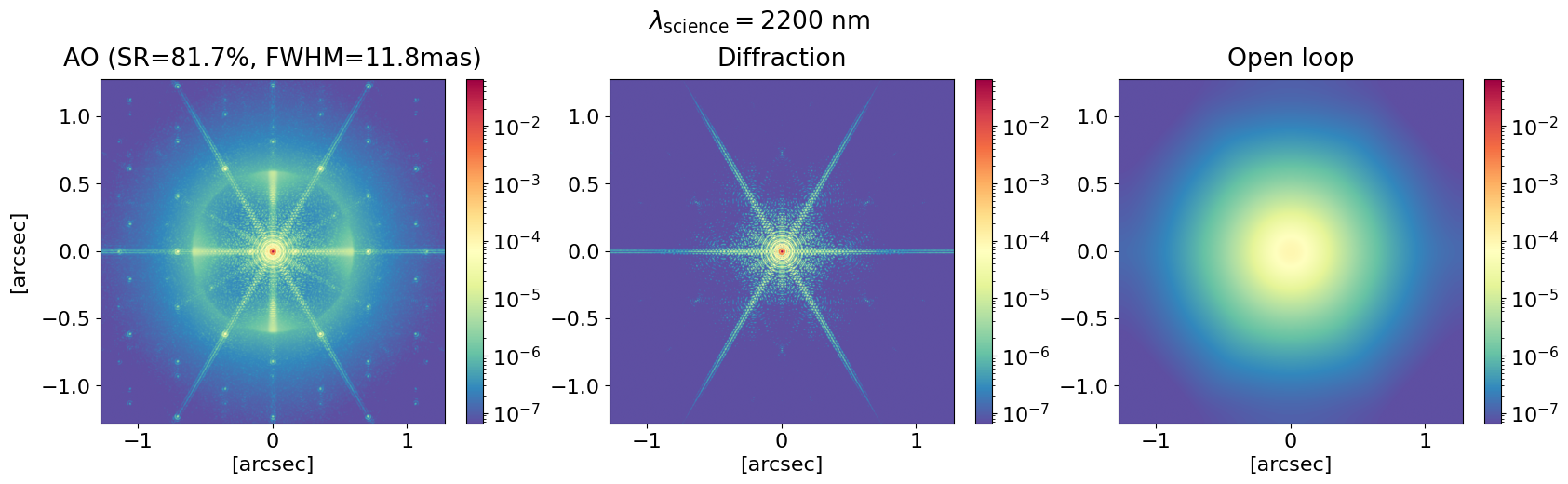
Loading...HARMONI SCAO NGS - PSFs
Parameter file (.ini format) - 🟣MCAO✨
An interface is available here to generate and run HARMONI MCAO simulations for specifics configurations.
View parameter file contents (.ini)
Loading...➡️MAVIS (MCAO-Assisted Visible Imager and Spectrograph)
MAVIS is intended to be installed at the Nasmyth A focus of the VLT UT4
(replacing Hawk-I/GRAAL) with the AOF and is made of two main parts:
an Adaptive Optics (AO) system that cancels the image blurring induced by atmospheric turbulence and its post focal instrumentation, an imager and an IFU spectrograph, both covering the visible part of the light spectrum.
(Text sourced from: https://www.eso.org/sci/facilities/develop/instruments/MAVIS.html#BasSpec)
AO mode used:
🟣 Multi Conjugate Adaptive Optics (MCAO)
Parameter file (.ini format) - 🟣MCAO✨
View parameter file contents (.ini)
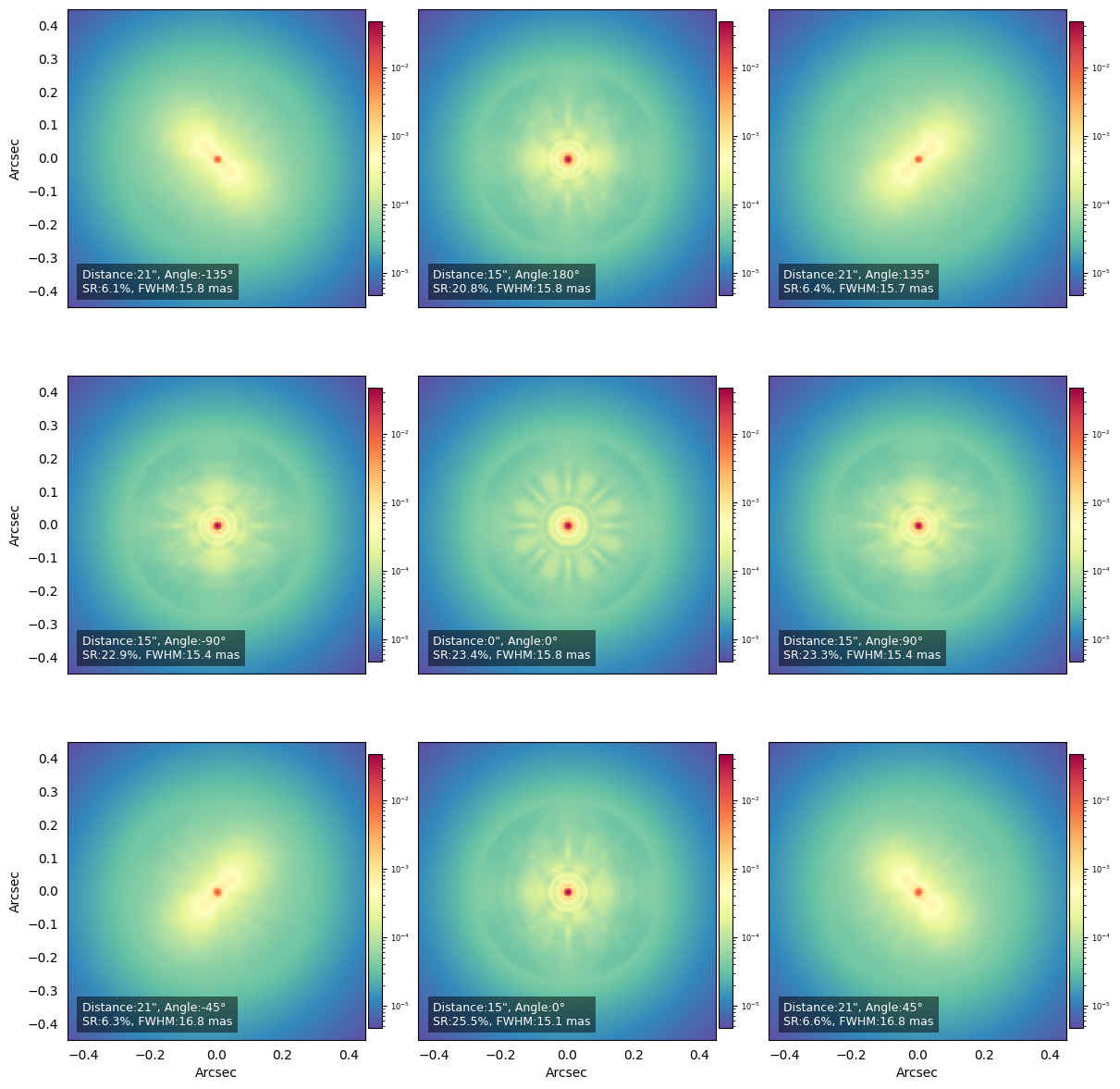
Loading...MAVIS MCAO - AO PSFs -
➡️METIS (Mid-infrared ELT Imager and Spectrograph)
METIS will be one of the first-generation ELT instruments. It will cover the infrared wavelength range
and make full use of the giant, 39-metre main mirror of the telescope to study a wide range of science topics, from objects in our Solar System to distant active galaxies.
(Text sourced from: https://elt.eso.org/instrument/METIS/)
AO mode used:
🔵 Single Conjugate Adaptive Optics (SCAO)
Parameter file (.ini format) - 🔵SCAO NGS✴️
View parameter file contents (.ini)
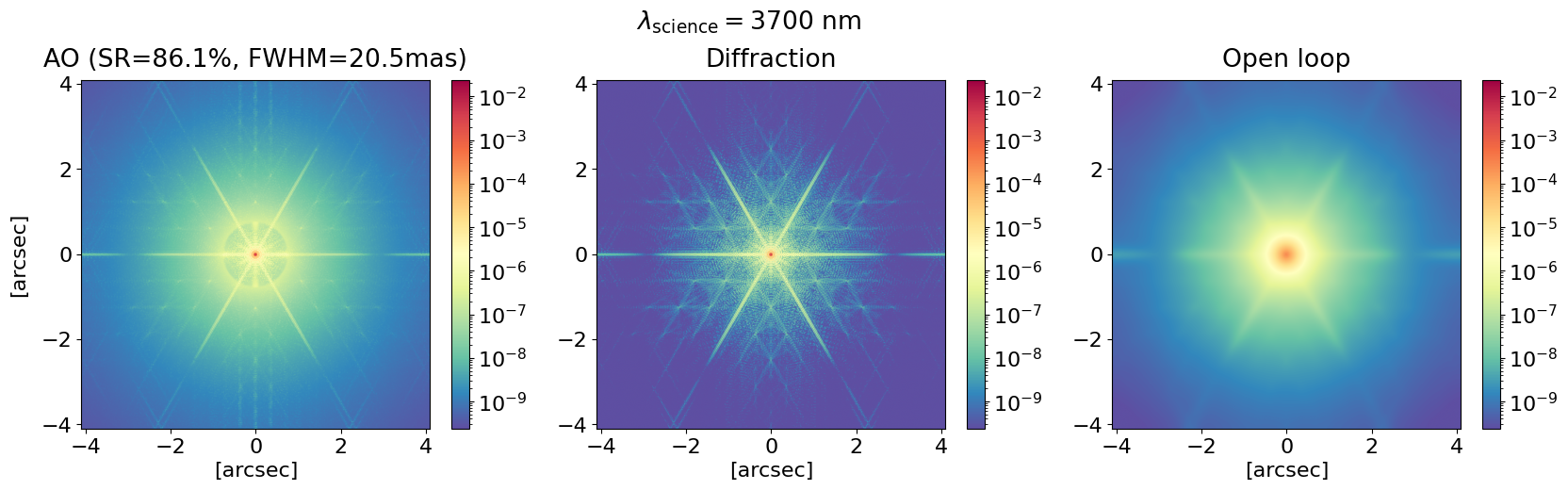
Loading...METIS SCAO NGS - PSFs
➡️MICADO (Multi-AO Imaging Camera for Deep Observations)
A first-generation ELT instrument, MICADO will take high-resolution images of the Universe at near-infrared wavelengths. This makes the instrument ideal for identifying exoplanets, but also for resolving individual stars in other galaxies and investigating the mysterious centre of the Milky Way.
(Text sourced from: https://elt.eso.org/instrument/MICADO/)
AO mode used:
🔵 Single Conjugate Adaptive Optics (SCAO)
Parameter file (.ini format) - 🔵SCAO NGS✴️
View parameter file contents (.ini)
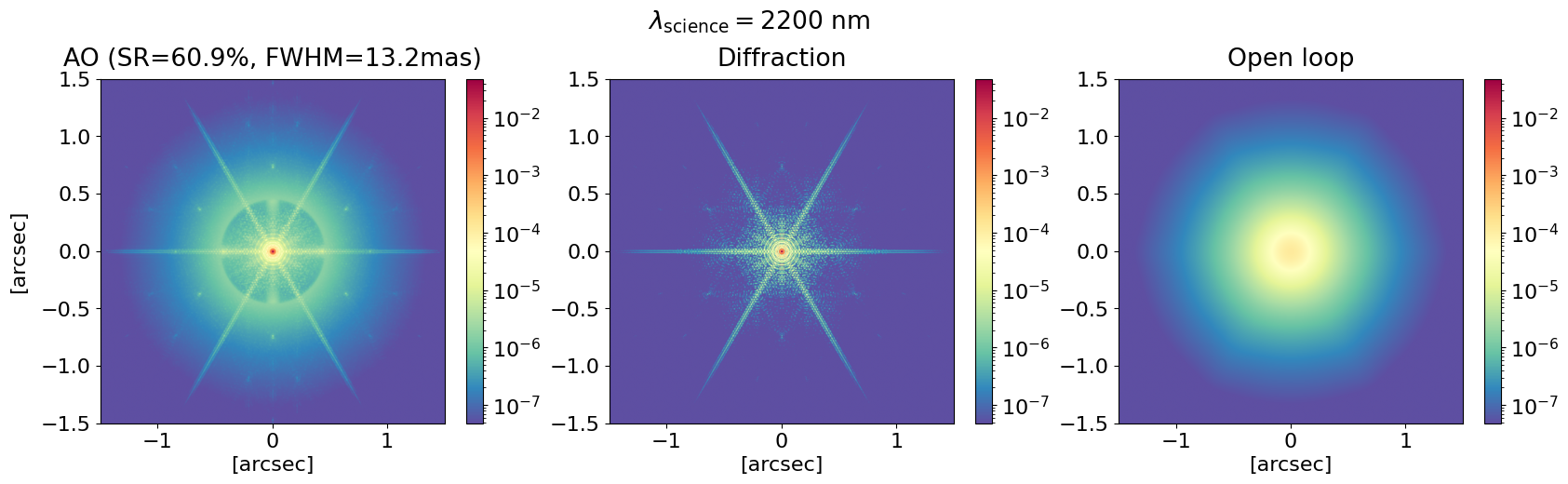
Loading...MICADO SCAO NGS - PSFs
➡️MORFEO (Multiconjugate adaptive Optics Relay For ELT Observations)
As a first-generation ELT instrument, MORFEO, will help compensate for the distortion of light caused by turbulence in the Earth’s atmosphere which makes astronomical images blurry. MORFEO will not make observations itself; rather, it will enable other instruments, such as MICADO in the first instance, to take exceptional images.
(Text sourced from: https://elt.eso.org/instrument/MORFEO/)
AO mode used:
🟣 Multi Conjugate Adaptive Optics (MCAO)
Parameter file (.ini format) - 🟣MCAO✨
View parameter file contents (.ini)
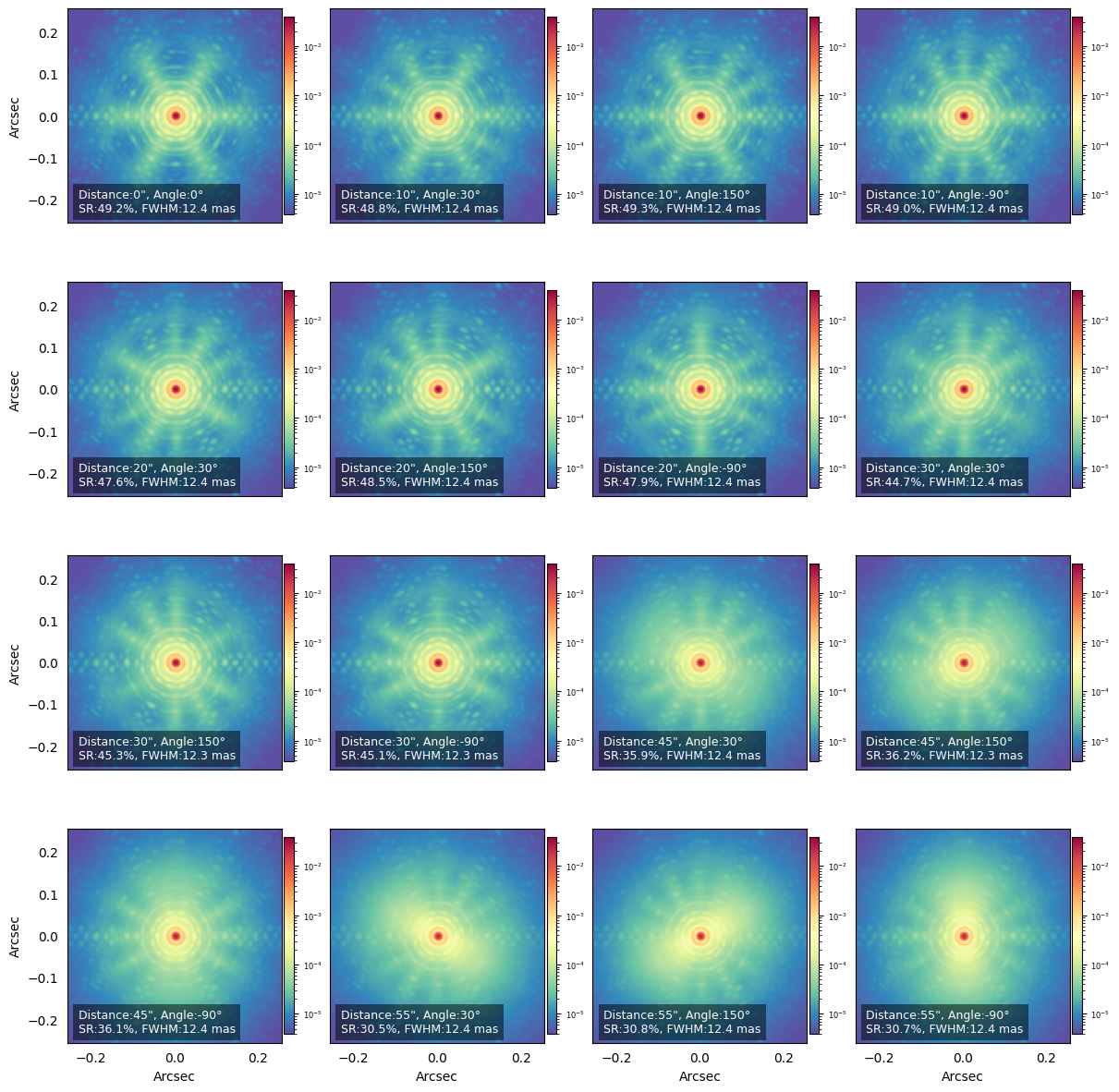
Loading...MORFEO MCAO - PSFs -
➡️MUSE (Multi-Unit Spectroscopic Explorer)
MUSE is an Integral Field Spectrograph located at the Nasmyth B focus of Yepun, the VLT UT4 telescope. It has a modular structure composed of 24 identical integral-field units (IFU) that together sample, in Wide Field Mode (WFM), a near-contiguous 1 squared arcmin field of view. Spectrally the instrument samples almost the full optical domain with a mean resolution of 3000. Spatially, the instrument samples the sky with 0.2 arcseconds spatial pixels in the Wide Field Mode with natural seeing (WFM-noAO).
(Text sourced from: https://www.eso.org/sci/facilities/paranal/instruments/muse/overview.html)
AO modes used:
🟤 Ground Layer Adaptive Optics (GLAO)
🟢 Laser Tomography Adaptive Optics (LTAO)
Parameter file (.ini format) - 🟤GLAO
View parameter file contents (.ini)
Coming soon...
Parameter file (.ini format) - 🟢LTAO
View parameter file contents (.ini)
Loading...➡️SOUL (Single conjugated adaptive Optics Upgrade for LBT)
AO mode used:
🔵 Single Conjugate Adaptive Optics (SCAO)
Parameter file (.ini format) - 🔵SCAO NGS✴️
View parameter file contents (.ini)
Loading...SOUL SCAO NGS - PSFs
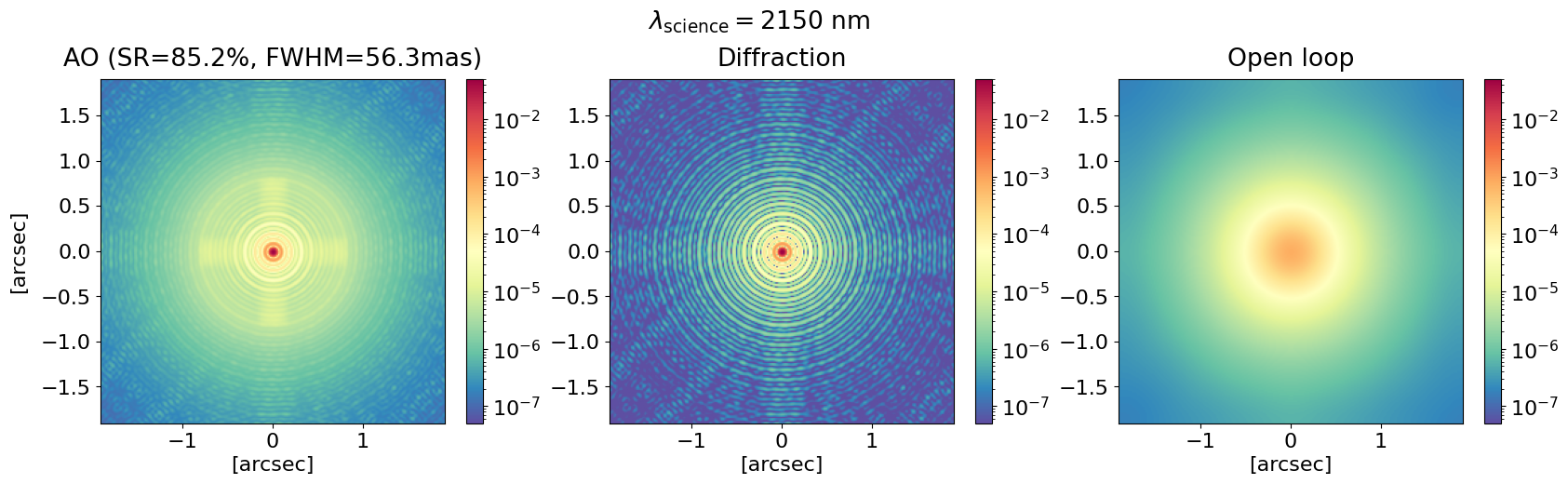
➡️SPHERE (Spectro-Polarimetric High-contrast Exoplanet REsearch)
SPHERE is an extreme adaptive optics system and coronagraphic facility feeding three science instruments: IRDIS, IFS, and ZIMPOL. The primary science goal of SPHERE is imaging, low-resolution spectroscopic, and polarimetric characterization of extra-solar planetary systems. The instrument design is optimized to provide the highest image quality and contrast performance in a narrow field of view around bright targets that are observed in the visible or near infrared. SPHERE is installed at the UT3 Nasmyth focus of the VLT.
(Text sourced from: https://www.eso.org/sci/facilities/paranal/instruments/sphere/overview.html), More information can be found at: https://www.eso.org/sci/facilities/paranal/instruments/sphere.html
AO mode used:
🔵 Single Conjugate Adaptive Optics (SCAO)
Parameter file (.ini format) - 🔵SCAO NGS✴️
View parameter file contents (.ini)
Loading...SPHERE SCAO NGS - PSFs